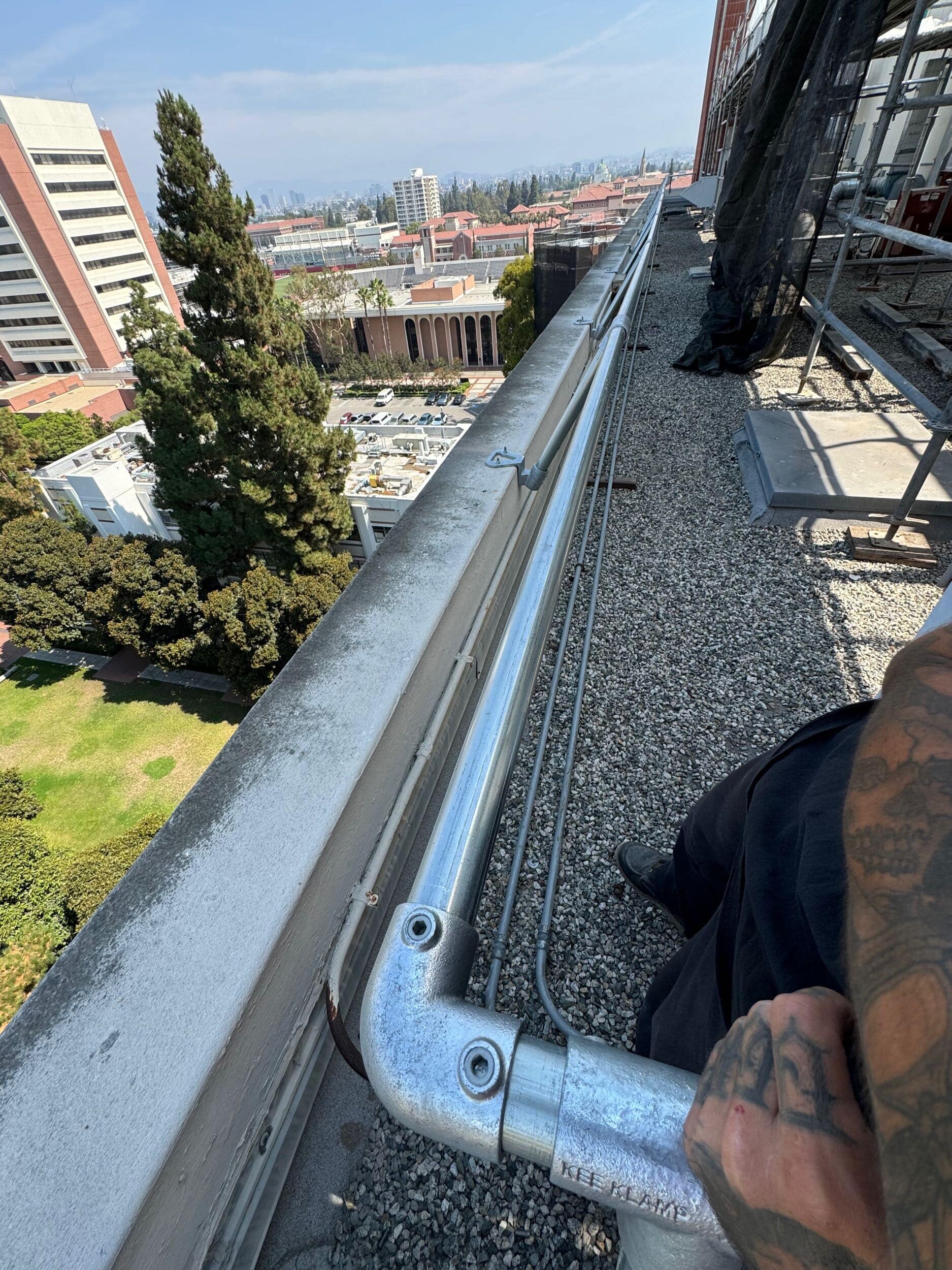
Most rooftops are not one-time job sites. Crews return to them constantly to service HVAC units, drains, exhaust fans, and solar arrays, and every trip near an unguarded edge is a fall hazard. A permanent guardrail removes that risk for good.
At Title 8 Builders, we design, fabricate, and install permanent guardrail systems that anchor into your building structure and stay in place year after year, with no weighted bases to reposition and no moving parts to maintain. The result is reliable fall protection that guards your crews and keeps your facility audit-ready from one inspection to the next.
The right setup depends on your roof type, parapet height, foot-traffic patterns, and which hazards your crews actually approach. Title 8 Builders specifies and builds the full rooftop guardrail system in-house, matching every component to your roof during the engineering phase so you receive one documented fall protection solution rather than a box of parts.
Mounted Guardrail. A permanent mount guardrail bolts directly into the parapet, roof curb, or structural deck, creating a fixed barrier along any exposed perimeter. This is the backbone of rooftop edge protection.
Parapet and Edge Rail. Continuous railing engineered to your parapet profile, sealing off long runs of open edge along the working side of the roof.
Guardrail at Hatches and Access Ladders. Protective railing around a roof hatch opening and at ladder landings, where workers transition onto the roof and exposure is highest.
Integrated Access Gates. A self-closing safety gate closes the opening at a ladder or hatch so an access point never sits open as an unguarded fall hazard.
Custom Fabricated Guardrail. Rail built to fit roofs that do not match a standard layout, including tight equipment clusters, irregular geometry, and unusual setbacks. See our custom fabrication capabilities.
For roofs where the membrane cannot be penetrated, we also build non-penetrating guardrail as a ballasted alternative.
A permanent roof guardrail system is a fixed, building-anchored barrier that runs along the open edges of a roof to stop workers from falling to the level below. Unlike portable or weighted setups, it fastens directly into the parapet, roof curb, or structural deck, forming a passive fall protection system that works without harnesses, worker training, or active monitoring. Because the rail is permanently secured, it delivers consistent rooftop safety every day a crew steps onto the roof.
A complete rooftop guardrail combines a top rail, a midrail, and posts spaced to code, each sized to withstand the loads a worker can place on them. The top rail forms the primary safety railing a person contacts, the midrail closes the gap beneath it, and the posts transfer that load into the structure. Together they turn an exposed roof edge into a guarded walking surface that satisfies Cal/OSHA from the first inspection forward.
Title 8 Builders engineers every guardrail around the specific roof it serves. Our team evaluates the deck, parapet, and structure, specifies rail placement and load paths, selects materials suited to the environment, and delivers a fully documented installation that meets Cal/OSHA and ANSI safety standards.
Commercial and Industrial Rooftops. Buildings with frequent rooftop maintenance need a fixed barrier at the edge so technicians can reach equipment without a fall hazard on every visit. Permanent rail protects crews servicing HVAC, drains, and ventilation throughout the life of the roof.
Data Centers and Energy Facilities. Equipment-dense roofs carry constant traffic around cooling and power systems. A permanent perimeter rail keeps crews protected without slowing the access that these data centers and utilities depend on.
Healthcare and Education Campuses. Hospitals and schools maintain large, multi-building footprints where rooftop access is routine. Standardized guardrail across the campus simplifies training, inspection, and compliance for healthcare and education facilities.
Roofs With Solar Arrays. Solar panels create new walking pathways and restricted zones that change how crews move across a roof. Engineered guardrail and crossovers keep those routes guarded as maintenance frequency rises.
Hatches, Skylights, and Access Points. Openings in the roof surface are among the highest-risk features on any building. Guardrail and screens secure these points so they never become an open fall hazard.
Existing Buildings Needing Code Upgrades. Older roofs that lack compliant edge protection can be brought up to current requirements with a retrofit. Surface-mounted rail installs on in-service roofs without major structural alteration. Learn more about system retrofitting and compliance upgrades.
California’s regulatory standard for fall protection goes beyond what federal OSHA requires, and roof edges are explicitly covered. The California Code of Regulations, Title 8, sets specific mandates for how guardrail systems must be sized, built, and documented, and the building owner carries responsibility for compliance.
Title 8 Builders designs every roof project to satisfy these requirements before the system enters service. Our engineers produce PE-stamped structural calculations for each installation, and every system is documented to support your Cal/OSHA records.
Because a permanent barrier protects workers without depending on anyone to set it up correctly, an engineered guardrail is the most dependable path to a roof that passes inspection the first time and stays compliant year after year.
Engineered for Your Roof, Not a Template. Every layout starts with an analysis of your actual roof, parapet, and deck. We do not apply generic drawings, and every set of calculations is PE-stamped for that specific installation through our design and engineering team.
Passive Protection That Needs No Training. A fall protection guardrail protects everyone on the roof the moment they arrive, with no harness to don and no procedure to follow. That makes it the most foolproof option for roofs where crews rotate or contractors come and go.
Built to Protect Roof Integrity. A new safety system should never void an expensive roof warranty. We specify non-penetrating and ballasted options where the membrane should not be compromised, and we coordinate with your roofing contractor when penetrations are necessary, protecting your roof and its warranty coverage.
Coordinated With Your Roofing System. We design for compatibility with diverse roofing materials, including TPO, PVC, built-up roofing, and metal deck, so the rail is compliant and its connection to the structure is sound. A barrier is only as strong as the substrate it attaches to.
A Long-Term Cost Advantage. Warning lines and flags depend on constant monitoring and fail the moment someone forgets them. A permanent guardrail eliminates that daily risk and the recurring cost of temporary measures, making it the more economical choice for any building on a regular maintenance schedule.
Title 8 Builders handles assessment, engineering, fabrication, installation, and certification entirely in-house.
Step 1: Assess and Design. On-site evaluation of your roof, traffic patterns, structure, and hazards, with a layout engineered to your roof’s specific conditions. Start with a fall hazard assessment.
Step 2: Engineer. Our in-house team produces CAD layouts and PE-stamped structural calculations specifying rail placement, load paths, and materials.
Step 3: Fabricate and Install. We fabricate the system in-house and our trained crews install it to the engineer-of-record’s specifications exactly, working around your operating schedule. See our installation process.
Step 4: Test and Certify. System verification and full documentation to support your Cal/OSHA compliance, with inspection and recertification available to keep the system audit-ready over time.
Single-Source Delivery. Engineering, fabrication, installation, and certification all happen through our team. Fewer hand-offs mean faster completion and less room for the coordination failures that slow multi-vendor projects.
Site-Specific Engineering on Every Project. Every guardrail layout begins with an analysis of your actual roof, and every set of calculations is PE-stamped for that installation.
Built for Roofs That Do Not Fit the Mold. Equipment clusters, mixed roof materials, tight setbacks, and added solar pathways are the conditions we work with every day. We build around real-world constraints, not in spite of them.
Rooted in California. Based in Valencia and working across the state, Title 8 Builders focuses exclusively on fall protection and facade access safety solutions for California buildings.
Permanent roof guardrail is one part of the full range of systems we build for aerospace, data centers, healthcare, education, utilities, government, and logistics facilities. View all of the industries we serve.
Tell us about your roof and we will scope the project. Title 8 Builders handles the engineering, fabrication, installation, and certification, so you get a compliant, documented system without managing multiple vendors.
A permanent roof guardrail system is a fixed barrier anchored into a building’s parapet, curb, or deck that runs along the open edges of a roof to prevent falls. Because it is bolted in place rather than weighted or portable, it provides passive protection that works without harnesses or training and stays compliant year after year.
Under California Title 8 standards, a compliant guardrail has a top rail 42 to 45 inches above the walking surface, with a midrail roughly halfway down and posts spaced no more than 8 feet apart. Title 8 Builders engineers each system to meet these dimensions for your specific roof.
A compliant guardrail must withstand at least 200 pounds of concentrated force applied in any downward or outward direction without failure. Cal/OSHA adds a live-load requirement of 20 pounds per linear foot, which is why guardrails on California roofs should be engineered rather than bought off the shelf.
Not always. Where the membrane should not be compromised, we specify non-penetrating or ballasted rail that protects the roof and preserves warranty coverage. When penetrations are the right structural choice, we coordinate with your roofing contractor to keep the warranty intact.
If workers are exposed to an unprotected edge during rooftop maintenance, California Title 8 requires fall protection, and the building owner is responsible for compliance. A permanent guardrail is the most reliable way to meet that obligation because it protects everyone on the roof without depending on equipment being set up correctly.
A permanent guardrail is a fixed physical barrier that stops a fall on contact and requires no monitoring. A warning line only marks a setback and depends on workers staying behind it, so it offers far less protection. For roofs with regular access, a permanent guardrail is the more dependable and lower-maintenance choice.