How Our Non-Penetrating Guardrail Systems Work
Most fall protection providers sell off-the-shelf hardware or design a system and then hand the work to a subcontractor. We do it differently. Every project is assessed, engineered, fabricated, and installed by our own team, so the safety rail that lands on your roof matches the engineering exactly. No guessing, no telephone game, no surprises during inspection.
Our non penetrating guardrail system includes:
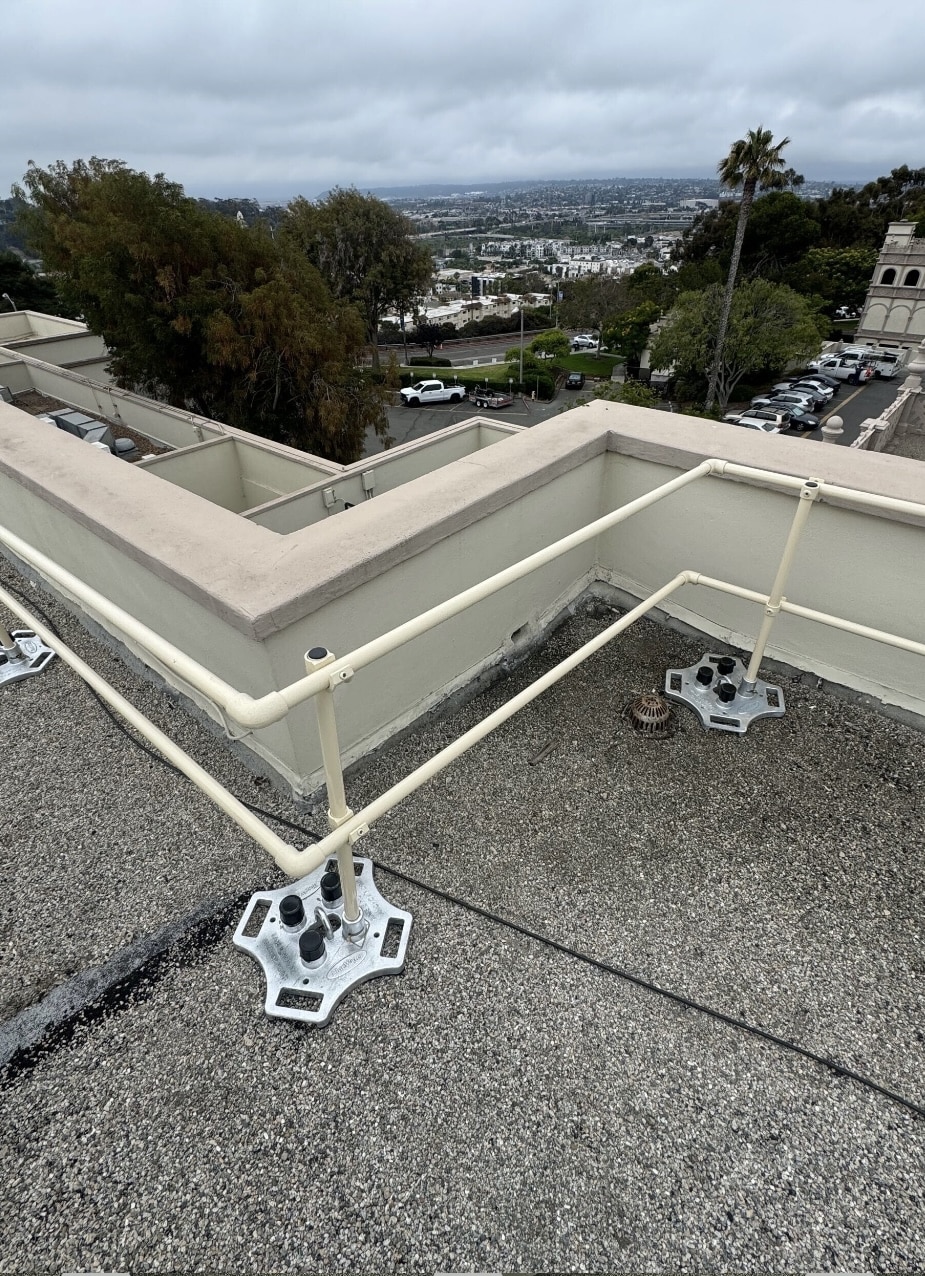
- A 42-inch top rail and mid-rail roof railing that meets Cal/OSHA and OSHA load requirements
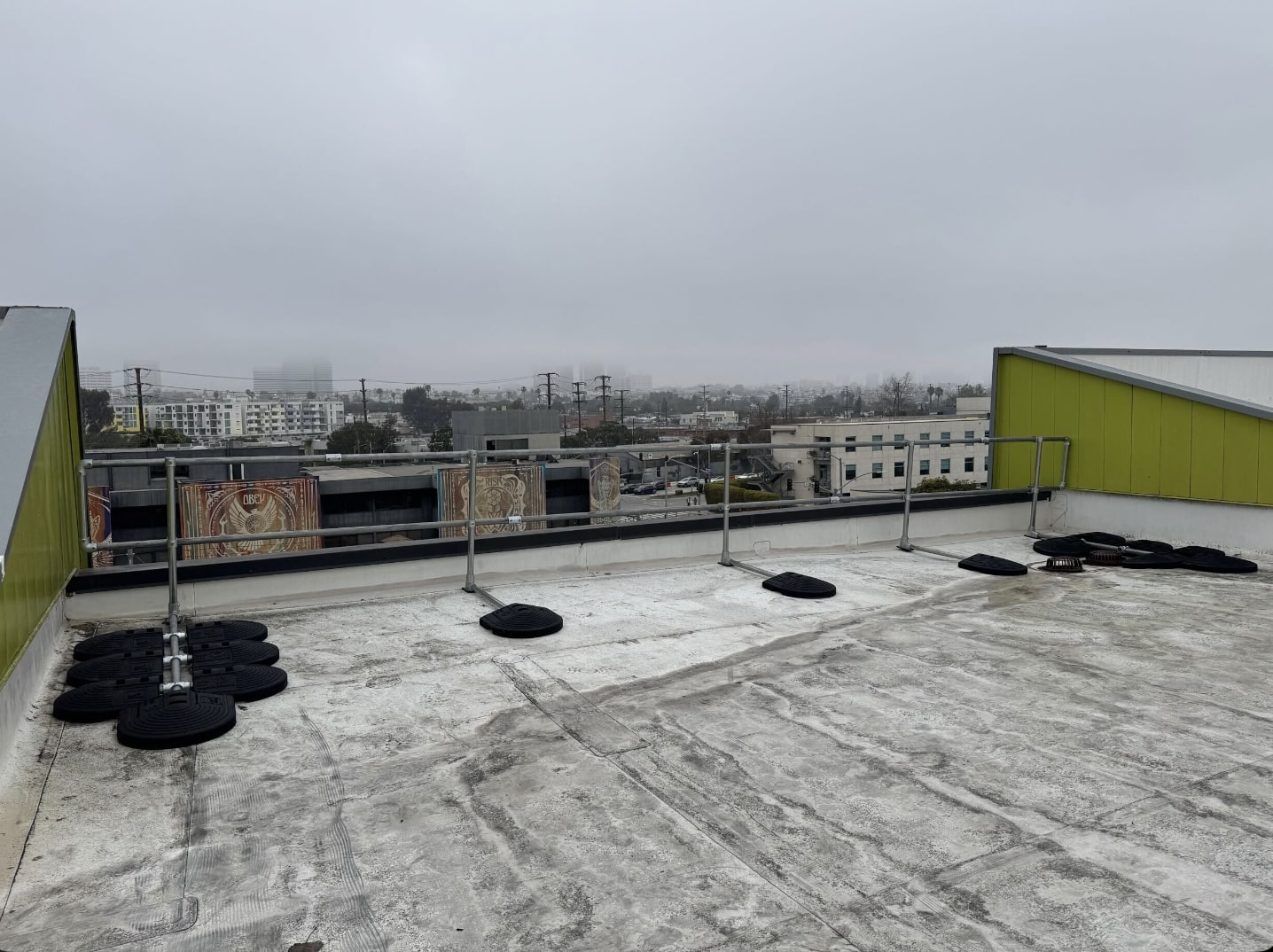
- Counterweighted bases made from recycled PVC or rubber that distribute load across the membrane
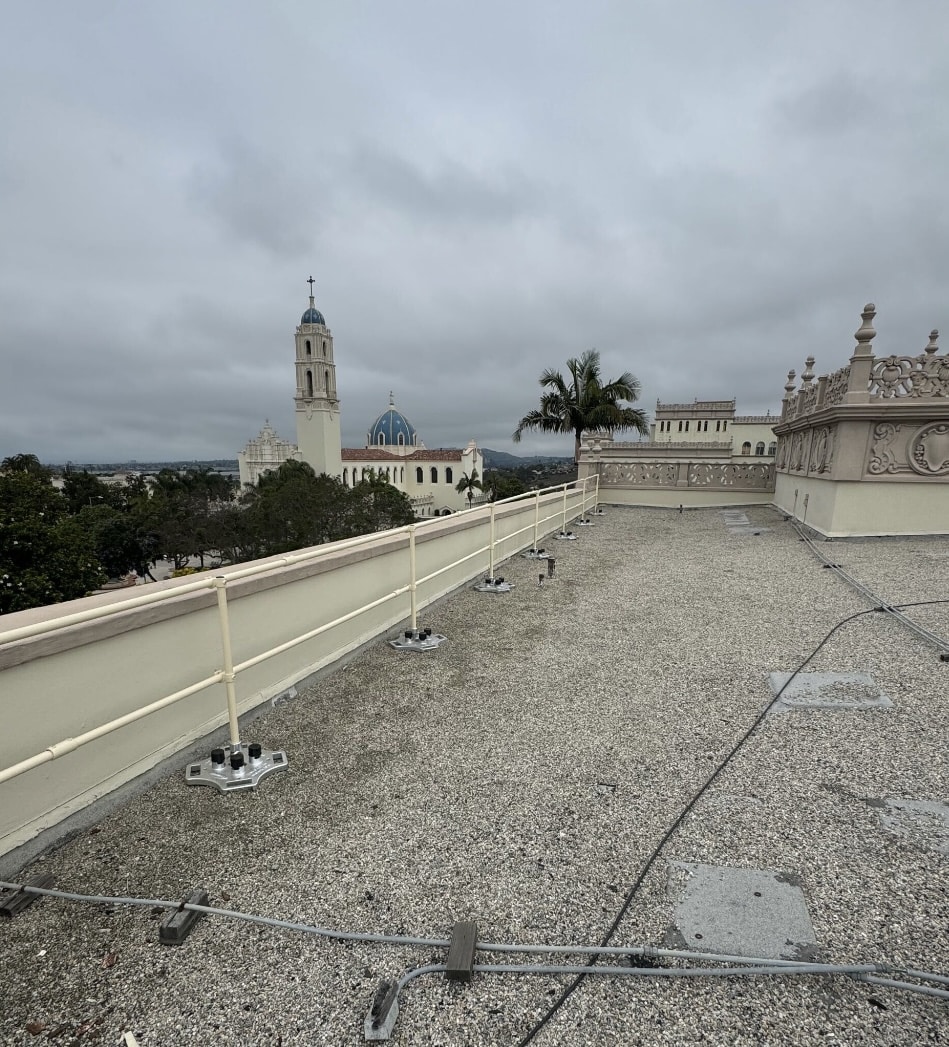
- Modular sections that connect into a continuous barrier around the roof edge, RTUs, hatches, skylights, and walkways
- PE-stamped drawings and load calculations for your compliance file
- Wind load engineering specific to your building’s height, exposure, and California microclimate
- Finish options including hot-dip galvanized steel, 316-grade stainless for coastal sites, and powder coating for visible or architectural roofs
- Compatibility with TPO, PVC, EPDM, modified bitumen, BUR, asphalt, and concrete deck
- On-site load verification and clean as-built documentation at project close
Because the system is modular, sections can be reconfigured later when you add solar, swap out HVAC units, or change rooftop traffic patterns. You won’t have to redesign from scratch.
Key Benefits of Roof Guardrails
Non-penetrating guardrails solve a problem most facility managers don’t want to admit they have: the cheapest way to add a fall protection system is also the fastest way to void a roof warranty. Here’s what you get when the safety guardrail stays above the membrane.
Your roof warranty stays intact. No roof penetration means no flashing and no warranty disputes with the membrane manufacturer.
The system grows with your facility. Modular sections can be added, moved, or reconfigured as the rooftop changes.
Maintenance burden stays low. Unlike cable lifeline systems, guardrails don’t require annual engineering recertification. A periodic visual inspection by a competent person is enough.
You pass Cal/OSHA inspection the first time. Our safety solutions are engineered to California’s stricter standards, not just federal minimums.
Durability for any environment. Corrosion-resistant finishes are designed to withstand harsh rooftop safety conditions year after year.
Our Installation Process
We keep the process tight because we control every step in-house.
Step 1: Rooftop Assessment & Design Site evaluation, fall hazard mapping, structural analysis, and roof layout engineered to your building’s specific conditions.
Step 2: PE-Stamped Engineering Our in-house engineers produce stamped plans and load calcs that hold up to Cal/OSHA inspection and insurance audits.
Step 3: Custom Fabrication & Installation Professional installation by our trained crews, following the engineer-of-record’s specifications exactly.
Step 4: Load Testing & Cal/OSHA Certification Proof load with full documentation for Cal/OSHA compliance records.
Related Fall Protection Services & Systems
If your roof has more than one hazard, we can address them all under one contract.
Why California Standards Are Stricter Than Federal OSHA
Cal/OSHA enforces guardrail and fall protection requirements that go beyond federal safety standards in several specific ways, including stricter height thresholds, tighter load criteria, and enhanced rules for suspended access and anchor systems.
A rooftop guardrail that passes federal OSHA inspection can still fail a Cal/OSHA review. Our systems are engineered to the stricter Cal/OSHA standard from the start, which is why our clients pass inspection the first time.
Specific benchmarks our non-penetrating guardrails are engineered to:
- Cal/OSHA Title 8, Article 5 (§3209 and §3210) for guardrail design and load criteria
- OSHA 1910.29(b)(3) and 1926.502(b)(3) for federal leading edge fall protection load standards
- ANSI/ASSP Z359 series for fall protection components and design
If your facility was previously protected by a system that meets only federal OSHA, a retrofit is usually less expensive than people expect. Ask about it during the assessment.
Why Title 8 Builders for Non-Penetrating Guardrail Installation
Single-Source Delivery. Engineering, fabrication, installation, testing, and certification all happen through our team. Fewer hand-offs mean faster project completion and less room for the coordination failures that slow down multi-vendor projects.
Site-Specific Engineering on Every Project. Every roof guardrail system starts with a structural analysis of the actual building, and every set of calculations is stamped by a licensed engineer for that specific installation.
Built for Buildings That Don’t Fit the Mold. Title 8 has the fabrication capability and field experience to build solutions around complex safety challenges. We treat workplace safety as an engineering problem to solve, not a checkbox to tick.
Rooted in California. Based in Valencia and working across the state, Title 8 Builders focuses exclusively on fall protection and facade access systems for California buildings.
Get an Assessment for Your California Rooftop
Every facility has its own mix of roof type, equipment layout, access patterns, and compliance history. We’d rather walk your roof and recommend the right guardrail system than quote from a catalog. The on-site hazard assessment is free, and the recommendations are scoped to what your building actually needs.
We’re headquartered in Valencia and serve facilities throughout California, from the Bay Area to San Diego, including the Central Valley and the high desert.